Emotion wheel: needs satisfied or unsatisfied
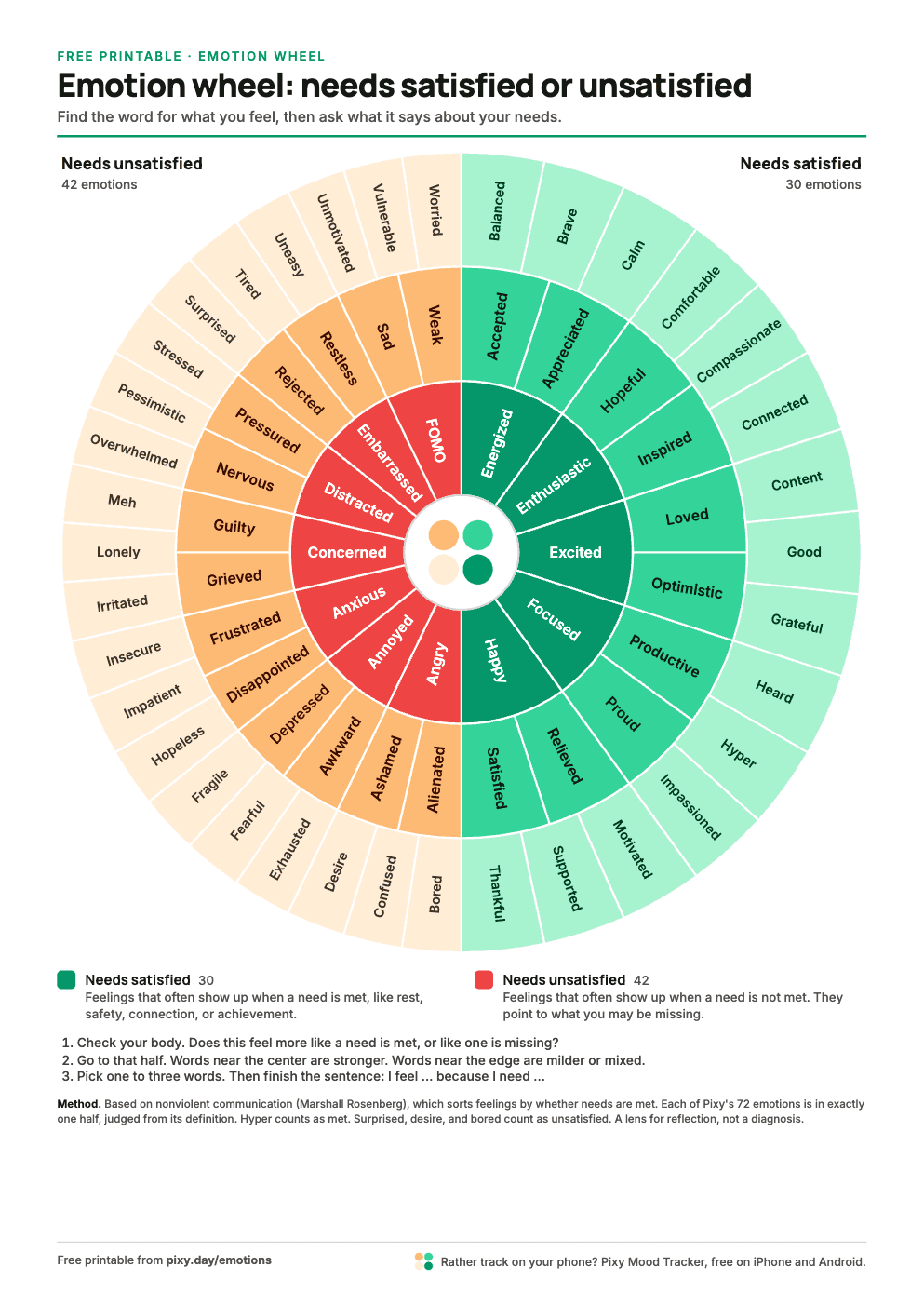
Two halves: feelings that often show up when a need is met, and when it is not.
pixy-emotion-wheel-needs-a4.pdf · pixy-emotion-wheel-needs-letter.pdf
Every emotion in the Pixy mood tracker, each with a one-line definition. Find the word for what you feel, then learn how naming it helps.
Grouped the way Pixy groups them, from very pleasant to very unpleasant. Every emotion has its own link.
72 of 72 emotions
Pixy's five groups, from very pleasant to very unpleasant. This is how the app sorts them.
How we sorted. “Pleasant / unpleasant” starts from Pixy's five groups: very pleasant and pleasant count as pleasant, unpleasant and very unpleasant as unpleasant. “Neutral” is its own group for emotions with no clear tone, or where it depends on the situation. 8 emotions differ from the app group because their definition says otherwise, for example Thankful (pleasant) and Confused (unpleasant). “Needs satisfied / unsatisfied” follows the feelings lists of nonviolent communication: feelings we have when needs are met, and when they are not. Every emotion is in exactly one group per view. These are judgment calls, not a diagnosis.
This list helps you find words. It is not a diagnosis. If heavy feelings last for weeks or get in the way of daily life, talk to a doctor or a mental health professional.
Two wheels with all 72 emotions, as PDF for A4 or US Letter. Stronger emotions sit near the center, milder ones toward the edge. Hang one up or keep it in your journal.
Two halves: feelings that often show up when a need is met, and when it is not.
pixy-emotion-wheel-needs-a4.pdf · pixy-emotion-wheel-needs-letter.pdf
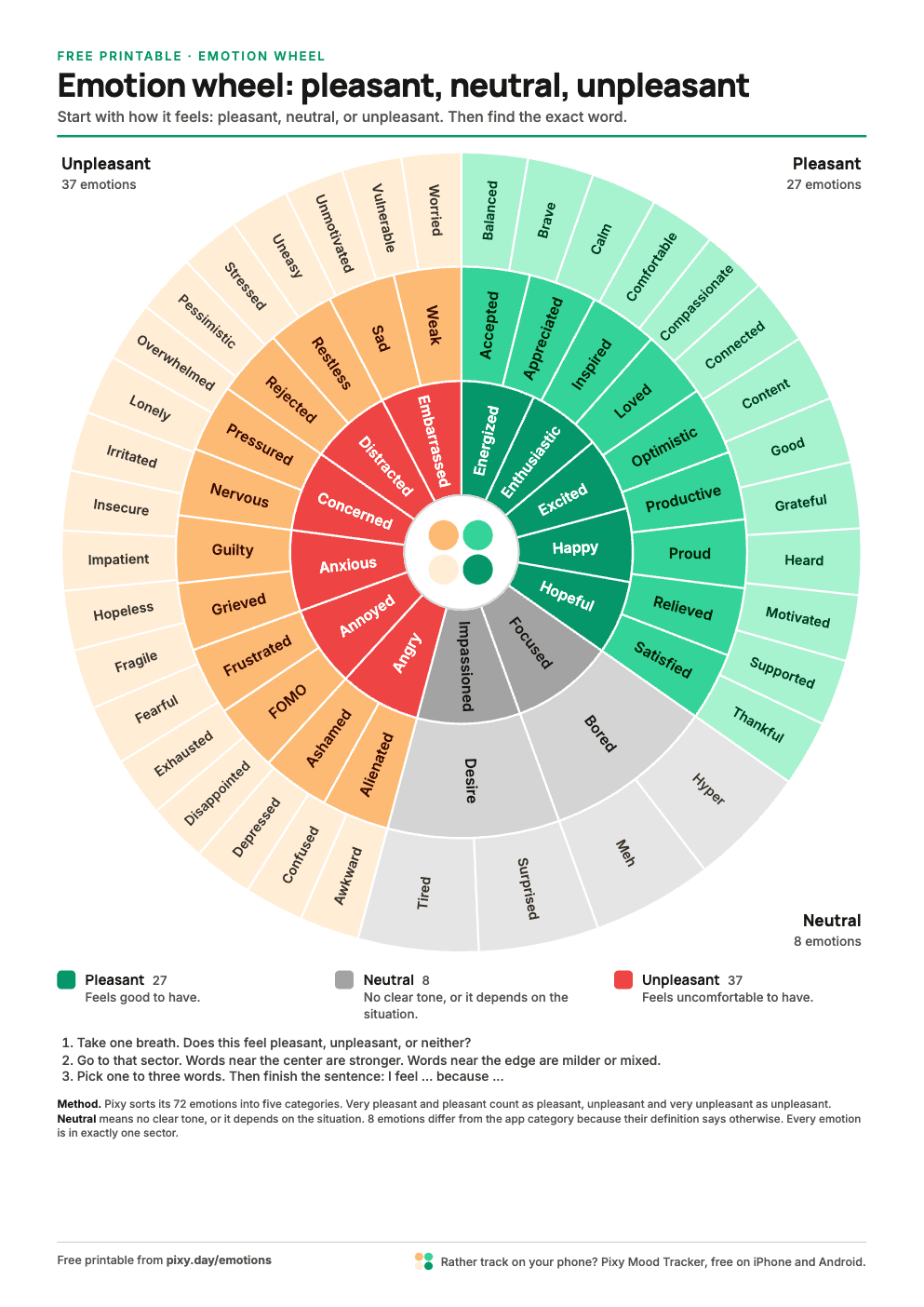
Three sectors: start with how a feeling feels, then find the exact word.
pixy-emotion-wheel-pleasantness-a4.pdf · pixy-emotion-wheel-pleasantness-letter.pdf
People use the three words as if they meant the same. Psychologists separate them by how long they last and how clear the cause is.
A short reaction to something that happens. Your body reacts too: heart rate, breath, face.
The way you experience an emotion and put it into words. It is your conscious read of what your body does.
A longer, milder state that colors the whole day. You often cannot say what caused it.
In everyday speech the words overlap, and that is fine. This page uses “emotion” and “feeling” for the words in the list, and “mood” for the overall rating of your day.
Psychologists call it affect labeling: putting a feeling into words. Research suggests it can take some of the edge off a strong emotion.
In a 2007 UCLA brain-imaging study, people looked at angry or scared faces. When they picked a word for the emotion, their amygdala reacted less than when they picked a name for the person. A region in the prefrontal cortex that helps regulate emotion became more active.
A 2018 review describes affect labeling as implicit emotion regulation. You do not try to change the feeling. You only name it, and the emotional response often gets smaller anyway.
In a 2012 study, people afraid of spiders described their feelings while near a live spider. A week later their bodies reacted less to a new spider than people who used other strategies. Their self-reported fear was about the same.
“Bad” is one word. “Disappointed”, “lonely” and “exhausted” are three different problems with three different fixes. Research on emotional granularity links finer distinctions between negative emotions with healthier ways of coping under stress.
Most of these studies ran in labs with small groups, and effects are modest. Naming a feeling is a helpful habit, not a treatment.
Use this as a quick emotional check-in, once a day or whenever a feeling gets loud.
Take one slow breath. Where do you feel something: chest, stomach, shoulders, face? Is your energy high or low?
Start broad: does this feel pleasant, unpleasant, or mixed? Then scan that group in the list above and pick the word that fits best. Two or three words are fine.
Finish the sentence “I feel … because …”. A short note turns a passing feeling into something you can look back on and learn from.
A mood tracker works best with two layers: one rating for the day and a few words for the emotions behind it. Here are both, ready to copy into a bullet journal or a spreadsheet.
This is Pixy’s mood scale. Seven steps give enough room for an average day without making you agonize over the choice.
These are the 30 emotions Pixy shows first. They cover most days. Add the other 42 when you want more precise words.
Want to see a whole year at once? Read about the Year in Pixels mood calendar.
An emotion wheel arranges feelings in rings: a few core emotions in the middle, finer words toward the edge. The best known are Robert Plutchik’s wheel of emotions and Gloria Willcox’s Feeling Wheel from 1982.
A wheel is great for exploring. A list is faster when you already know roughly what you feel and want the exact word. Pixy uses a list, sorted from very pleasant to very unpleasant, and shows a definition when you pick a word.
Want a wheel anyway? Print one of the two free wheels above. They use the same 72 words as the list.
In the app
Rate your day on 7 colors, then tap the emotions that fit. Try it on the phone: tap an emotion to see its description.
Reviews
FAQ

Pixy is free, has no ads and needs no account. Your entries stay on your phone.